From 29 to 31 October, the 27th China Annual Conference for International Education (CACIE) was held at the China National Convention Center in Beijing. Professor Du Chengming, Member of the Standing Committee of the CPC Committee and Vice President of Guangdong University of Technology (GDUT), attended the conference upon invitation and served as co-chair of the 7th China–U.S. Provincial/State University Presidents Forum, a parallel forum of this year’s annual conference.
The China–U.S. Provincial/State University Presidents Forum is hosted by the China Education Association for International Exchange (CEAIE) with special support from the American Association of State Colleges and Universities (AASCU). This year’s forum was themed “AI Empowering the Transformation of Higher Education: Opportunities, Challenges and Practical Pathways for China–U.S. Provincial/State University Cooperation”, with a programme covering opening remarks, keynote speeches and a thematic discussion. Leaders of the two associations attended and addressed the forum, and presidents of a number of Chinese and U.S. provincial and state universities were present and spoke. Six university leaders served as panelists: representatives of Shaanxi University of Technology, Ludong University and Jiangsu University on the Chinese side, and of St. Cloud State University, Western Carolina University and Chicago State University on the U.S. side.
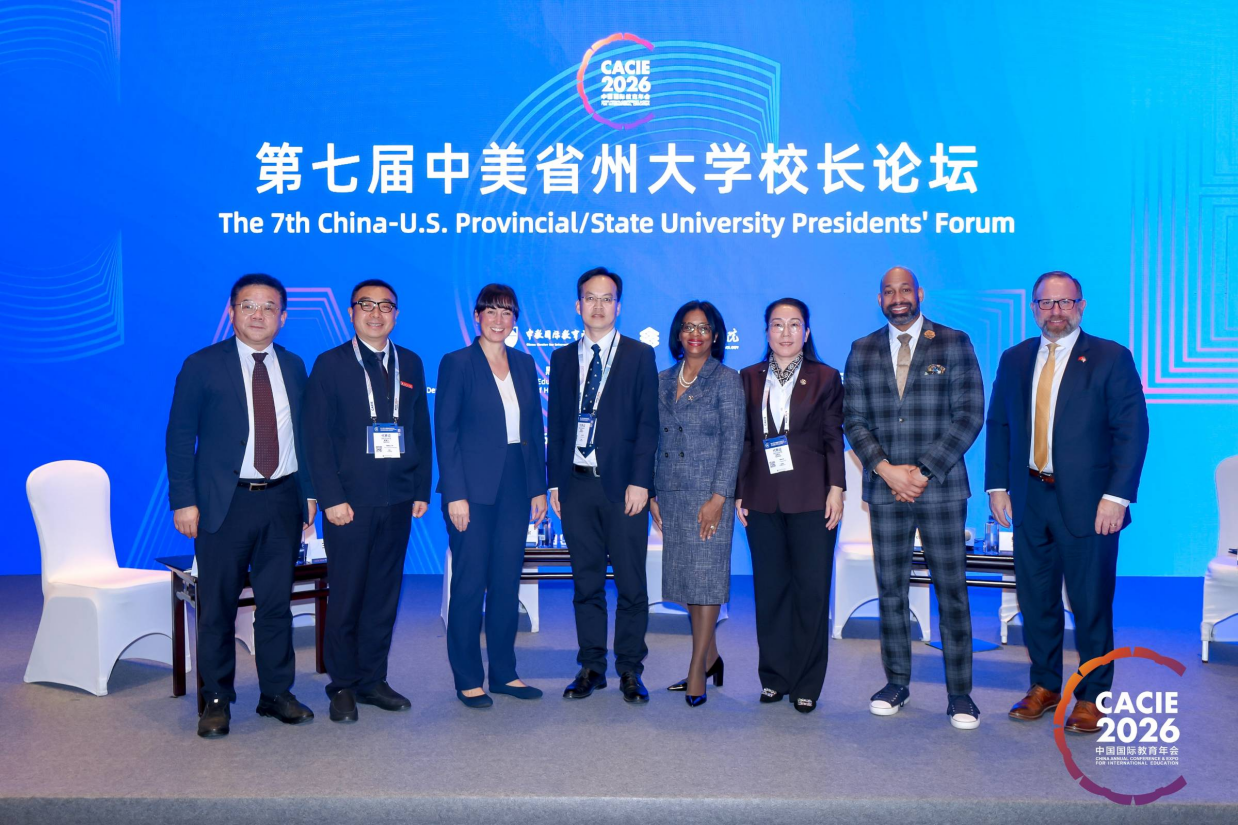
During the thematic discussion, Professor Du co-chaired the session with James Anderson, Vice Chancellor for Enrollment Management at the University of Massachusetts Dartmouth. The six panelists delivered remarks and exchanged views on three topics: AI and employment opportunities, resource sharing in the AI era, and trust, resilience and mutually beneficial cooperation.
Summing up the discussion, Professor Du noted that China–U.S. university cooperation has always championed resource sharing, and that in the AI era the resources available for sharing have extended from courses and textbooks to computing power, datasets and even large-model tools. Chinese and U.S. provincial and state universities, he said, should identify the resource areas that are “shareable, easy to share and most worth sharing”, and deepen practical cooperation in joint talent cultivation, research collaboration and faculty–student exchanges. Facing new circumstances and new challenges, he stressed that both sides should give full play to their respective features and strengths, improve regular exchange mechanisms, and make inter-university projects more substantive and relations more stable, so as to advance China–U.S. provincial/state university cooperation steadily and over the long term, and to jointly cultivate high-quality talent with an international perspective and innovative capability.